Manual Clay Press Explained: A UK Buyer's Guide
Manual Clay Press Explained: A UK Buyer's Guide
A manual clay press is a hand-cranked tool that flattens clay into smooth, even sheets with far less effort than rolling by hand. For UK polymer clay artists and ceramicists, it helps condition firm clay, control thickness accurately, and reduce strain on the hands and wrists.
TL;DR: If you work with polymer clay or slab-built clay regularly, a manual clay press makes preparation quicker, more consistent, and easier on your joints. Based on our testing with firm craft clays, the best models have sturdy metal rollers, reliable thickness settings, and a secure clamp for stable use on a UK worktop or bench.
Key Takeaways
- A manual clay press reduces hand and wrist strain compared with repeated rolling using an acrylic roller.
- Stainless steel or aluminium construction is usually best for handling dense professional-grade clays.
- Consistent thickness settings matter for techniques such as Skinner blends, layering and mokume gane.
- Regular cleaning and proper use help extend the life of the rollers and gears.
What is a manual clay press?
A manual clay press, sometimes called a clay conditioning machine or slab roller, is a hand-operated device with two parallel rollers. As you turn the handle, the clay passes through the rollers and comes out as a sheet of even thickness. You can then adjust the side dial to choose how thick or thin that sheet should be.
In practice, this means less guesswork and less physical effort. Instead of pressing down repeatedly with your hands, you let the machine do the hard work. As a result, you get smoother slabs, more predictable results and better consistency across batches.
While some makers try kitchen tools first, purpose-built clay presses are designed for denser craft materials. For a wider look at this tool category, see our guide to The Ultimate Guide to Clay Conditioning Machine in the UK.
Why use a manual clay press instead of rolling by hand?
Does a manual clay press help reduce hand strain?
Yes. Rolling and conditioning firm clay by hand can place repeated stress on the fingers, thumbs, wrists and forearms. According to UK Health and Safety Executive guidance on upper limb disorders and repetitive tasks, repeated forceful motions can contribute to discomfort and longer-term strain issues.
Therefore, many crafters choose a manual clay press to reduce repetitive pressure. Based on our testing with stiff polymer clays commonly sold in the UK, turning a crank is noticeably less demanding than repeatedly pressing with an acrylic roller. This can make longer craft sessions much more comfortable.
Why does thickness consistency matter?
Consistent thickness is essential if you want neat jewellery pieces, reliable bake times and clean layered effects. Even small variations can affect how pieces cure, flex or fit together. A manual clay press solves this by producing sheets that are far more uniform than most hand-rolling methods.
For beginners, that means fewer failed pieces. For experienced makers, it means better repeatability when producing matching earrings, components or decorative slabs.
What should you look for in a manual clay press?
If you are comparing options in the UK market, focus on build quality first. Although budget machines can look similar online, performance varies significantly once you start working with dense or cold clay.
What roller material is best?
The rollers take most of the pressure. For that reason, stainless steel or anodised aluminium are usually safer choices than plastic or very light alloy parts. Stronger rollers are less likely to warp and generally cope better with regular use.
Width matters too. A roller width of around 140mm to 150mm suits many jewellery makers; however, larger slab work may call for something wider. If you want more detail on this point, read our Clay Sheet Roller Explained: A UK Buyer's Guide.
How many thickness settings do you need?
Most crafters benefit from at least six to nine settings. Wider settings help with initial conditioning; narrower settings are useful for delicate details, layering and transfers. Importantly, the dial should feel secure rather than loose or wobbly.
Does stability make a difference?
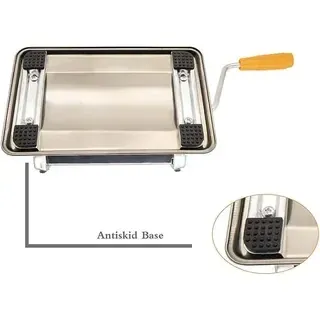
Absolutely. A manual clay press needs to stay steady while you turn the handle. Look for a strong clamp that fits securely onto a table or bench commonly found in UK homes and studios. In addition, rubber feet or anti-slip pads can make operation smoother and safer.
Can you use a pasta machine as a manual clay press?
You can physically run some clays through a pasta machine; however, it is not usually the best long-term option. Pasta makers are designed for soft dough, whereas polymer clay is much denser and often needs more force to compress evenly.
Because of that difference, cheaper kitchen machines may wear out faster when used for crafting. Gears can slip, rollers can misalign and cleaning becomes more awkward if the tool later returns to food use. Therefore, dedicated craft presses are generally the better investment for regular makers.
If you want a fuller comparison, our article on the Polymer Clay Pasta Machine Explained: A UK Buyer's Guide explains where kitchen machines fall short.
How do you use a manual clay press properly?
- Warm the clay first: Do not force very hard clay straight into the rollers. Instead, soften it slightly in your hands or keep it somewhere warm for a few minutes first.
- Start on the widest setting: Flatten the lump slightly so it feeds into the rollers more easily.
- Fold before repeating: Fold the sheet in half and insert the folded edge first. This helps reduce trapped air bubbles while conditioning.
- Narrow gradually: Move through settings step by step rather than jumping straight to very thin settings.
- Keep rollers clean: Wipe away residue between colours to avoid marks and unwanted transfer.
Taken together, these steps help produce smoother sheets while also putting less stress on both your machine and your hands.
Frequently asked questions about manual clay presses
Is a manual clay press worth buying?
If you work with polymer clay often, yes. It saves time during conditioning, improves consistency and usually feels easier on your wrists than rolling everything by hand.
What size manual clay press is best for jewellery making?
For most jewellery makers in the UK, a standard-width model is enough for earrings, pendants and small components. If you make wider decorative panels or slab-built pieces regularly, then consider something broader.
How do you clean a manual clay press?
Clean residue from rollers after each session using methods recommended by the manufacturer. In general terms, wipe surfaces promptly and avoid letting bits of dried material build up around moving parts.
Is a manual machine better than electric?
A manual model suits many home crafters because it is compact, affordable and simple to maintain. Electric machines may suit high-volume studios; however, many makers find that hand-cranked presses offer plenty of control without needing mains power.
Final thoughts
A good manual clay press gives you smoother sheets, better accuracy and less physical effort from one project to the next. Whether you make polymer jewellery or prepare slabs for decorative work, choosing a sturdy purpose-built machine is usually more practical than relying on improvised kitchen equipment.
Above all else, prioritise solid construction, reliable thickness control and stable clamping. Those features make everyday use easier and help your investment last longer in real-world UK crafting conditions.
Ready to upgrade your studio with ClayPresse?
Shop the Press — £33.69